Written by KJ Dahlaw
As part of the Dyke HERstory Dance Tour, we begin this project with our community engagement series, Dykon Story Hour. We are bringing in pairs of Bay Area Dyke Icons to share stories and engage in conversation around Dyke Identity. We are framing the conversations around these questions.
- What does Dyke identity mean to you?
- How has the meaning of Dyke changed through time?
- What are some favorite memories of Dyke community you have?
- Favorite stories of Bay Area Dyke Herstory?
- Who are the Dyke ancestors or elders that have deeply impacted your life and why?
- What is our Dyke legacy?
I’m gonna play and answer these questions for myself. Let’s engage. Comment on my thoughts and share your own!
What does Dyke identity mean to me?
First of all I love being a Dyke. It’s very gender for me. It appeals to my inner girl child that wanted to rule the world.
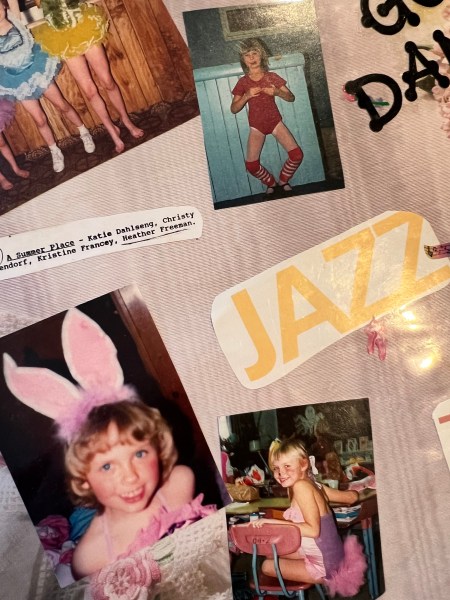
I loved being a girl with a willful determination that girls could do ANYTHING! Certainly, anything boys could do, we could do better. I grew up in the 80’s and 90’s in a confusing dichotomy of loving She-ra and Pippi Longstocking, Punky Brewster and Xena, the Warrior Princess, seeing women working full time jobs with a working mother who would often sing the iconic “I can bring home the bacon…” Enjoli jingle about the exhaustive 1980’s ideal of (white) women’s roles while being taught in church and in the home that women in Christianity were subordinate to men.
Naturally, being told that I was inferior in any way made me fiercely determined to prove them wrong. I have loved strong girls and women since early childhood. I just knew that by the time I had completed being a professional dancer, professional actor, teacher, astronaut, if there hadn’t yet been a woman President, I, of course, would have to change that and become the first woman President of the United States. So, you see, I felt a sense of belonging with girls and women and it gave me a lot of pride, a lot of gender euphoria. And while it took me wayyyyyyy to long (or just the time I needed) to come out of the closet (because I thought it was a sin and very shameful), when I finally did rip myself out of the homophobic, transphobic, white supremacist, Christian frame, it was because of Audrey Lorde, Judith Butler, Simone Debevouix, Riane Eisler helped re-shape my idealogy to embrace sovereignty, agency, and empowerment for myself. In other words, lesbian feminism helped me find the courage to come out.
I had spray painted my Doc Martin combat boots hot pink. I was an anti-war activist during the Iraq War in Chicago. I fervently studied Women Who Run With the Wolves, I led women’s circles, I co-organized an Anarcha Women’s Primitivist Gathering, I homebirthed my babies with Mid-Wives, I skinned roadkill and raised chickens and grew vegetables and brewed kombucha and made chicken stock. These are all examples of ways that I explored my agency and re-claimation of power in my young womanhood on the road to coming out as queer. All these experiences gave me gender euphoria.
When I finally exploded out of the closet, I had 2 young kids and a husband. Coming into my queerness in my 30’s, during the 2010’s, I delighted in the expansion of my self and identity without binaries. I distanced myself from womanness seeking the relief from harmful expectations and roles I had always played. I have delighted in third space gender exploration, embracing my own masculinity. Transness has given me the space to move across limitations and let go of rigid norms. I have needed the porous, spacious, expansive space of queer and trans identity.
When I came into Dyke space tho, I felt a resonance that spanned my whole lifetime. To me Dykes are badass, gender-transgressive warriors of intersectional queer liberation politics. IMO, Dyke identity is innately politcal as well as sexual. Dykes were on the front lines with transwomen and men and gay men at the Stonewell Riot in 1969. Dykes in the 80’s and 90’s were reorienting their lives to take care of their gay brethren who were suffering and dying of HIV/AIDS. Dykes have been organizing to fight oppression and celebrate marginal identities through the Dyke Marches. I am excited for all the dyke HERstory I still get to learn!
It is my perception that being a dyke is a political alignment with intersectional liberation movements. Allison Bechdel showed this to me through her iconic Dykes to Watch Out For comic series. Credit is due to the Black, lesbian writers and activists who have shaped intersectional politics. Credit to Angela Davis, Audre Lorde, bell hooks, Barbara Smith, Cheryl Clarke, Jewelle Gomez among so many others in the shaping of the Black Feminist Liberation Tradition that has so deeply influenced the ethos of Dyke identity.
A Dyke is a badass
A Dyke is an anti-racist and protector of all those who hold marginalized identities.
A Dyke is an unapologetic advocate for women’s rights. trans rights, lesbian sovereignty, disability justice, Black liberation.
A Dyke is a gender rebel.
This is how I, KJ percieve being a dyke in 2026, Bay Area, CA.
What is your perception of being a dyke?
If you’d like to learn more about The Dyke HERstory Dance Tour and how to get involved, visit sarahbushdance.org/the-dyke-herstory-dance-tour/.

